

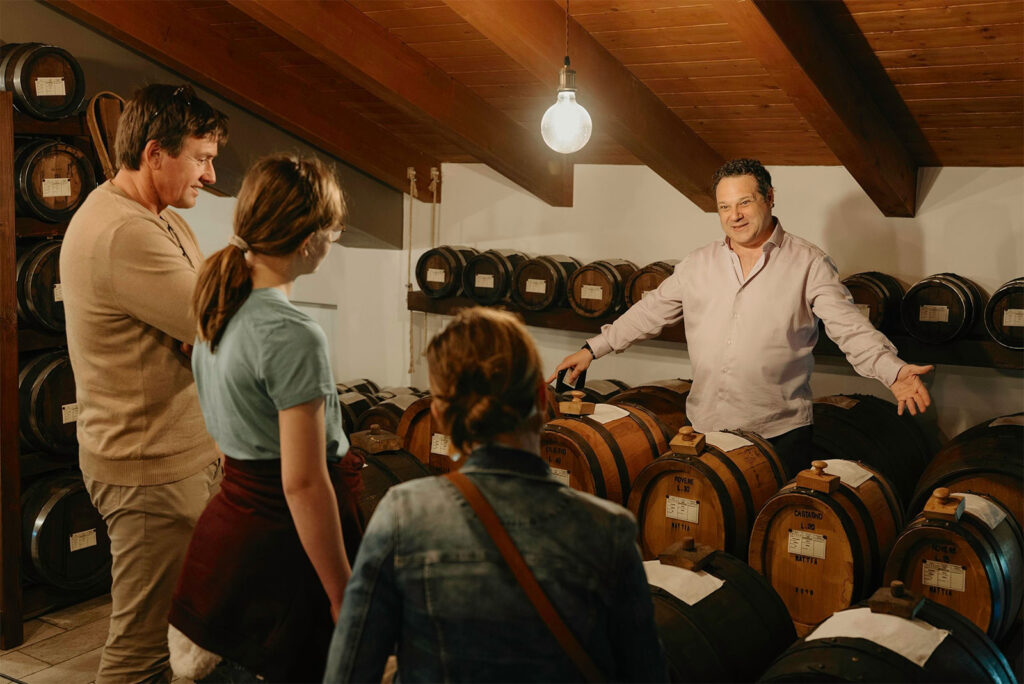
Entering an acetaia means observing up close a slow transformation: the grape loses its original form and, through successive stages, becomes balsamic vinegar of Modena, a product recognizable for its aroma, density, and sweet-and-sour flavor. This journey does not arise from a single process, but from a series of careful steps: the selection of the grape clusters, the cooking of the must, the resting phase, the passage through the barrels, and the checks repeated over time. Each stage adds something, gradually building a result that carries with it territory, tradition, and patient craftsmanship.
The journey begins before the barrels: the grape as the origin of quality
Before reaching the attics and the barrel batteries, balsamic vinegar begins in the vineyard. It is here that the quality of the base from which the entire process will start is determined. The most commonly used grapes are Trebbiano and Lambrusco, typical varieties of the Modenese territory, appreciated for their natural balance between sweetness and acidity. Harvesting takes place between September and October, when the grape clusters reach their ideal moment for picking.
Manual selection makes it possible to choose only the healthiest grapes, preventing damaged berries from compromising the purity of the must. After harvesting, pressing must be gentle: there is no need to crush forcefully, because skins, seeds, and stems could release bitter notes. The resulting liquid is then filtered and prepared for the next stage. At this point, it is not yet balsamic vinegar, but its future character is already beginning to take shape: a balanced, clean, and fragrant must will be the foundation for a more harmonious final product.
Must, cooking, and waiting: the transformation takes shape
Once the must has been obtained, the process enters a more intense phase. The liquid is cooked within 24 hours of pressing, in order to avoid uncontrolled fermentation and preserve a clean base. The cooking takes place in open steel vats over direct heat for 36 to 48 hours: a long period during which the must loses water, becomes more concentrated, and changes its aroma. From fresh grape juice, it turns into a darker, softer, and richer base, capable of supporting the years of maturation that will follow.
After cooking, however, the process does not move immediately to the barrels. The must has to be first cool down and settle, resting until January. This waiting period is essential, because it allows the liquid to stabilize and separate from any remaining impurities. Already at this stage, it becomes clear that excellence does not come from acceleration, but from the ability to respect every step: even when it seems that nothing is happening, the product is preparing for its next transformation.
Inside the acetaia: where wood and time complete the work
When the cooked must enters the barrels, the rhythm of the process changes. The heat of cooking no longer dominates; instead, the slow action of wood, air, and the seasons takes over. The barrel batteries are made up of casks of decreasing sizes, each one guiding the product through a different phase of its evolution. The liquid does not remain still: over the years it becomes more concentrated, denser, and richer in aromatic nuance.
Different woods – such as oak, cherry, chestnut, ash, mulberry, juniper, and acacia – help build its fragrance and complexity. In the attics, where the summer heat and winter cold alternate strongly, balsamic vinegar finds the ideal conditions to mature according to tradition. Human work also remains essential: transfers, top-ups, and tastings make it possible to follow the product’s evolution and adjust levels when necessary. It is inside the acetaia that the grape, now transformed into cooked must, completes its journey toward a condiment capable of containing time, territory, and productive memory.
Acetaia Leonardi: a family supply chain between vineyards, courtyard, and barrels
Within this transformation process, Acetaia Leonardi represents a concrete example of a supply chain followed from beginning to end. The company is centered around the Antica Corte dei Campi Macri, in Magreta di Formigine, where the agricultural dimension remains central: about 10 hectares of vineyards, cultivated mainly with Trebbiano di Modena and Lambrusco, provide the estate’s own raw materials. From here takes shape a closed-cycle model, in which the harvest, the processing of the must, the maturation, and the bottling all remain tied to the same place and the same family.
The origins of Acetaia Leonardi date back to the 18th century, while since the second half of the 19th century balsamic vinegar production has become the heart of the business. Today, the story of this transformation is also told through the well-known Acetaia tours in Modena, where vineyards, barrels, and historic spaces help visitors understand how grapes can become a product of excellence without ever losing their connection with the land from which they come.