
For years, the dream of a perfectly manicured lawn without lifting a finger came with a massive “but.” First, it was the nightmare of burying miles of boundary wire. Then came RTK (Real-Time Kinematic) mowers, which traded wires for satellite antennas—only to fail the moment a cloud rolled in or the mower drifted under a large oak tree.
As we move through 2026, the industry has finally hit the “holy grail” of garden tech: The Zero-Infrastructure Setup. No wires, no base stations, and no signal anxiety. Here is why the latest generation of vision-based mowers is redefining “easy.”
The Evolution of “Easy Install”
To understand where we are, we have to look at how far we’ve come.
- The Wire Era: Installing a robot mower used to be a weekend-long project involving trenching, stakes, and the inevitable “wire break” that was impossible to find.
- The RTK Era: GPS-based mowers removed the wire but introduced “satellite line-of-sight” issues. If your yard had tall walls, heavy tree canopies, or lived in a “GPS dead zone,” the mower simply wouldn’t work.
- The AI Vision Era (2026): This is the current gold standard. Using onboard cameras and neural networks, these mowers “see” the world like humans do. They recognize grass vs. pavement instantly, requiring nothing more than a simple walk-through to map the area.
Why “RTK-Free” is the Game Changer
The shift away from RTK is significant. By removing the dependency on external satellites and fixed base stations, homeowners gain three major advantages:
- Reliability: The mower doesn’t stop just because it went under a porch or a dense tree.
- Aesthetics: You no longer need to mount a clunky GPS antenna on your roof or in the middle of your garden.
- Speed: You can go from “unboxing” to “mowing” in minutes, not hours.
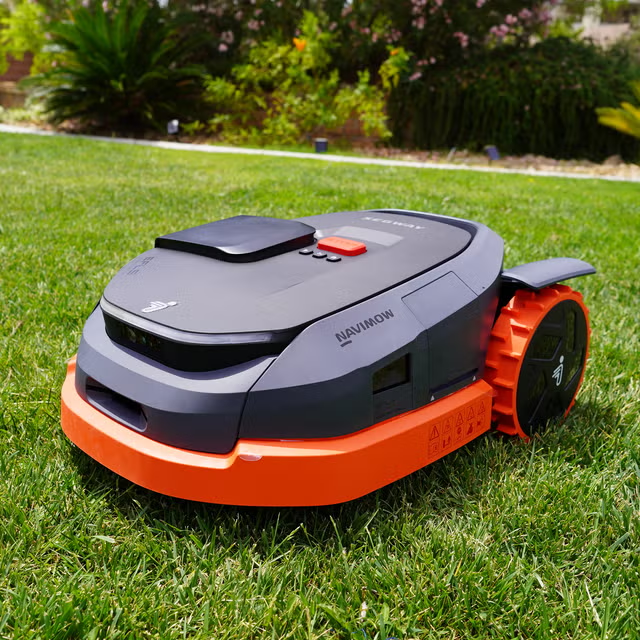
Featured Solution: MOVA Lidax Ultra 3000 AWD
While several brands are chasing this technology, the MOVA Lidax Ultra 3000 AWD stands out as the most refined example of the “install-and-forget” philosophy.
Instead of relying on unstable signals, it utilizes UltraView™ 3.0 AI mapping. This allows the mower to generate a precise digital map of your yard automatically without a single boundary wire or RTK base station.
Key highlights include:
- AWD Capability: Its UltraDrive™ system ensures that once it’s set up, it doesn’t get stuck. It handles complex terrains and steep slopes that usually require manual rescue for lesser robots.
- Precision Trimming: With UltraTrim™ 2.0, it solves the “edge problem,” using dual discs to cut closer to walls and fences than previous generations.
- Intelligence: It doesn’t just mow; it navigates. It can detect and avoid over 300 types of objects, meaning you don’t have to “prep” the yard by picking up toys or garden tools before it starts.
Choosing Your 2026 Mower: What to Look For
If you are shopping for a mower this year, don’t settle for yesterday’s tech. Ensure your choice meets these three criteria:
1. Multi-Zone Management
Modern yards are rarely one flat rectangle. Ensure your mower can handle complex layouts. The Lidax Ultra, for example, supports up to 150 different zones, making it perfect for homes with front, back, and side yards separated by paths.
2. Terrain Independence
An “easy install” is useless if you have to go outside and move the mower every time it hits a bump. Look for All-Wheel Drive (AWD) to ensure the robot can navigate mud, slopes, and thick grass autonomously.
3. Obstacle Awareness
The best installation is one where you never have to intervene. High-end AI obstacle avoidance ensures the mower remains an asset, not a liability that you have to watch constantly.
Conclusion
In 2026, the barrier to entry for robotic lawn care has never been lower. We have officially moved past the era of digging trenches and mounting antennas. With vision-based systems like the MOVA Lidax Ultra 3000 AWD, the “easiest install” is now a reality: you simply set it on the grass, let it see your yard, and reclaim your weekends.
Conclusion
In 2026, the barrier to entry for robotic lawn care has never been lower. We have officially moved past the era of digging trenches and mounting antennas. With vision-based systems like the MOVA Lidax Ultra 3000 AWD, the “easiest install” is now a reality: you simply set it on the grass, let it see your yard, and reclaim your weekends.